
By All Things Bev | allthingsbeverages.co.za
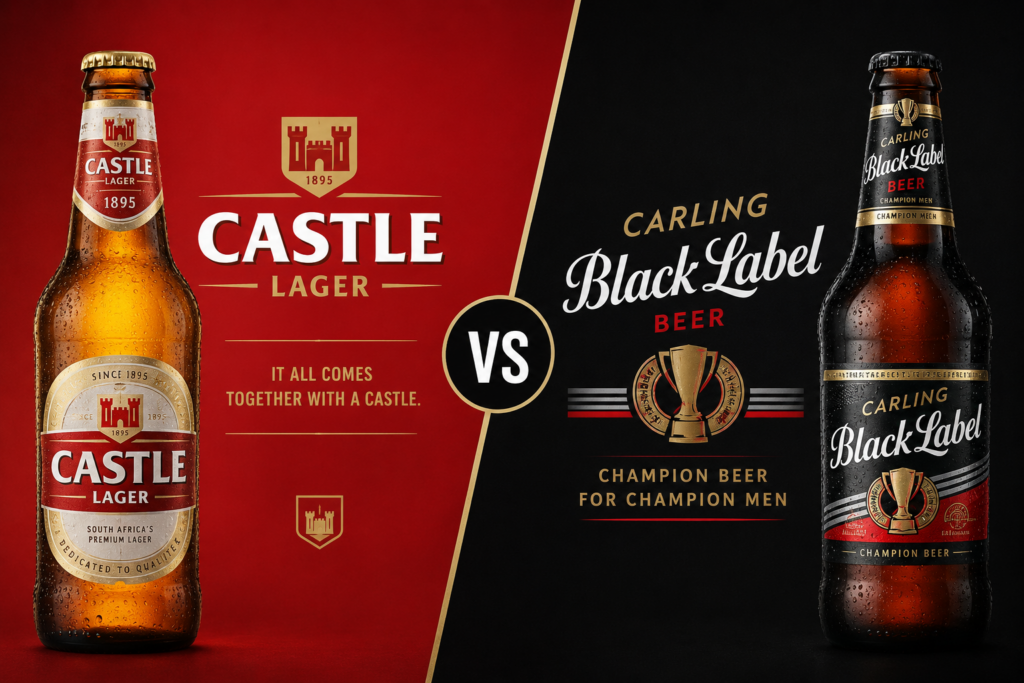
There are debates that divide families. Who’s the best Bafana Bafana coach of all time. Chiefs or Pirates. And then there’s this one — the one that’s been argued at every braai, in every shebeen, across every province, for decades.
Both are made by the same brewery (SAB, a subsidiary of AB InBev). Both are available at every bottle store in the country. Both cost roughly the same. And yet the loyalty each commands is fierce, tribal, and deeply personal.
This is your definitive, honest, no-nonsense guide to South Africa’s two greatest beers. We’ll cover the history, the ingredients, the taste, the culture, the stats — and yes, we’ll tell you which one is actually better.
Get a cold one. Let’s settle this.
The Origin Stories
Castle Lager: Born from the Gold Rush
Castle Lager’s story begins in 1886, when an Englishman named Charles Glass arrived in the new mining town of Johannesburg during the Witwatersrand Gold Rush. He noticed something the gold prospectors desperately needed: a reliable, quality beer. He founded the Castle Brewery and began selling his lager to the miners. By 1889, one of Johannesburg’s early newspapers, The Digger’s News, declared it “a phenomenal success.”
In 1895, the Castle Brewery’s success led directly to the founding of South African Breweries (SAB) — one of the most significant moments in the country’s industrial history. Two years later, SAB became the first industrial company to list on the Johannesburg Stock Exchange. Castle Lager won the World’s Best Bottled Lager award at the International Brewing Industry Awards in 2000, and is today brewed in nine countries and available in over 40 worldwide.
Castle Lager is 130 years old. It is the oldest and most historically significant beer brand in South Africa. It is South African brewing.
Carling Black Label: The Canadian Challenger
Carling Black Label arrived in South Africa considerably later, launched in 1962 by South African Breweries, bringing the successful Canadian brand to local shores. It was positioned from the start as a fuller-flavoured, slightly more premium alternative to Castle — and it quickly built a following among drinkers who wanted more body and character in their lager.
Carling Black Label has been quenching South Africans’ thirst for over 60 years. The brand built its identity around strength and achievement — “Brewed for Champions” became one of the most recognisable taglines in SA advertising — and aligned itself deeply with sport, music, and working-class pride.
For most of its life in South Africa, Black Label played second fiddle to Castle. Then, sometime around 2023, everything changed.
The Sales War: Who Actually Wins?
For most of South Africa’s modern beer history, Castle Lager was undisputed king. It was the first name South Africans thought of when the topic was beer. It was the national symbol. The cultural default.
Then Carling Black Label dethroned Castle Lager as South Africa’s top-selling beer, claiming the number one spot — and it hasn’t looked back since. Black Label has retained its position as the most consumed beer brand in the country, with nearly two million South Africans consuming it in any given week.
To put that in context: Black Label has retained its position as the most consumed beer brand in the country, with nearly two million South Africans consuming it in any given week. Castle Lite is third on the list, with over 1.25 million South Africans consuming it weekly.
The fact that Castle Lager doesn’t even make the top three in weekly consumption anymore — Castle Lite outsells it — is a remarkable turn of events for a brand that literally founded the country’s brewing industry.
laBlack Label is also the most valuable beer brand in South Africa, with 20 prestigious international beer awards to its name.
The Beer Itself: Ingredients & Brewing
Both beers are brewed by SAB at their breweries across South Africa. Both are pale lagers. Both use malted barley, hops, water, and yeast. But the details differ.
Castle Lager
- ABV: 5.0%
- Style: South African pale lager
- Ingredients: 100% South African — barley from the Caledon region, maize from the Free State, and hops from the Waboomskraal Valley near George
- Tagline: “Somewhat dry, somewhat bitter, never sweet”
Castle Lager’s brewing philosophy is rooted in local terroir — every ingredient in the bottle is grown in South Africa. The barley comes from the cool wheat-and-barley-growing region around Caledon in the Western Cape. The maize (yes, maize — like most lagers globally, Castle uses an adjunct alongside malted barley) is sourced from the Free State’s golden grain belt. The hops come from a single valley near George.
In 2023, Castle pulled off a remarkable innovation: they incorporated the acoustic energy from 62 million South African fan cheers during the Rugby World Cup into a limited-edition brew through sonic infusion technology, using sound vibrations to subtly influence fermentation. Wild concept. Very on-brand.
Carling Black Label
- ABV: 5.5%
- Style: Premium South African pale lager
- Ingredients: Malted barley, maize, hops — bold earthy character, spicy hoppiness from lightly kilned malted barley, subtle fruity notes
- Tagline: “Brewed for Champions”
Black Label’s key brewing distinction is its ABV: at 5.5%, it’s half a percentage point stronger than Castle — not dramatic, but meaningful. It also uses a higher proportion of malted barley relative to adjuncts, which gives it more body and fuller flavour than Castle’s lighter profile.
The SAB brand description is unapologetically bold: “Hold Carling Black Label up to the light and look for the unmistakable colour and clarity of its golden liquid. Its bold, earthy flavour notes showcase its masculinity. Easy to drink, with a smooth finish that lingers for just the right amount of time, this refreshing character is unexpected from a brew so round and flavourful.”
Head to Head: How Do They Actually Taste?
Appearance
Castle: Pale golden, light amber — a lighter, cleaner golden colour. Clear and well-carbonated with a white head that dissipates relatively quickly. Black Label: Slightly deeper golden colour with that unmistakable clarity that the brand makes a point of. Medium carbonation, slightly fuller appearance in the glass.
Advantage: Black Label — marginally richer colour and slightly more visual appeal.
Nose (Aroma)
Castle: Clean cereal grain, light malt sweetness, a hint of grassy hops. Fresh and uncomplicated. True to its “never sweet” ethos — there’s no overt fruitiness, just a clean, inviting lager aroma. Black Label: Slightly more pronounced — biscuity malt, a touch of earthiness, light spice from the hops, and subtle fruity notes in the background. More complexity on the nose than Castle.
Advantage: Black Label — more aromatic character.
Taste
Castle: The tagline tells the story perfectly. Somewhat dry — the finish is clean without residual sweetness. Somewhat bitter — there’s a genuine but gentle hop bitterness that sets it apart from many SA lagers. Never sweet — Castle actively avoids the cloying quality that cheapens many mass-market lagers. It’s crisp, balanced, and refreshingly honest. Medium-light body with lively carbonation.
Black Label: Fuller-bodied and more assertive. The higher ABV translates into more flavour — sweet biscuity malt upfront, then a balance of grassy hops, a hint of earthiness, and a spicy finish that lingers pleasantly. It’s more satisfying in each sip — more there in the glass.
Advantage: Black Label — more body, more flavour, more complexity. Castle is more delicate; Black Label is more confident.
Finish
Castle: Short to medium, clean and dry. Refreshing. Invites the next sip. Black Label: Medium, slightly warmer finish (partly the higher ABV). That spicy, earthy hop note lingers just enough to be satisfying without overstaying its welcome.
Advantage: Black Label — longer, more satisfying finish.
Drinkability
Castle: Wins here. The lighter body, lower ABV, and clean profile make it more sessionable — you can drink more Castle over a longer period without fatigue. Perfect for a long braai afternoon. Black Label: Slightly more filling. The extra body means it’s more of a considered beer — you notice you’re drinking it in a way you don’t always with Castle.
Advantage: Castle — more sessionable, more approachable for longer drinking occasions.
The Cultural Dimension
If the taste comparison gives Black Label the edge, the cultural comparison is more complicated and more interesting.
Castle Lager is heritage. It is nostalgia. It is the 1995 Rugby World Cup and Nelson Mandela lifting the Webb Ellis Cup. It is 130 years of South African brewing history. It is the beer your father drank, and his father before him. Castle has sponsored the Springboks for decades — and when South Africa wins a Rugby World Cup, Castle cans appear in the celebration photos almost by instinct.
In 2025, Castle marked its 130th anniversary with Heritage Collectors Cans — a series of six limited-edition designs honouring each decade of the beer’s history. The brand’s emotional connection with South African identity runs deep in a way that no newcomer can replicate.
Carling Black Label is achievement. It is the present tense. It is hustle, sport, community, and the pride of working-class South Africa. The “Brewed for Champions” positioning isn’t just a slogan — it’s embedded in the brand’s sponsorship of PSL football through the Carling Knockout Cup, its deep ties to township culture, and its genuine cross-demographic appeal that cuts across income, race, and geography more effectively than any other beer brand in the country.
The Black Label loyalty is different from Castle loyalty. Castle drinkers feel nostalgic. Black Label drinkers feel proud. Both are powerful emotional connections — they just draw from different places.
Price: Is There Actually a Difference?
Both beers sit at essentially the same retail price point — the difference between a 750ml Castle and a 750ml Black Label at any bottle store is typically a few rand at most, and often nothing at all.
Approximate SA retail prices (750ml returnable bottle):
- Castle Lager: R18–R24
- Carling Black Label: R18–R25
At this price point, neither beer represents anything other than exceptional value. The extra body and higher ABV in Black Label arguably makes it the slightly better value proposition — more beer character per rand.
The Verdict: Which Is Actually Better?
Here’s the honest answer, broken down by occasion:
Best for a long braai afternoon: Castle Lager. The lighter body and clean profile make it more sessionable over several hours. You can drink six Castles at a braai and feel great. Six Black Labels and you’ll feel it by sunset.
Best for flavour: Carling Black Label. More body, more complexity, more satisfying in individual sips. If you’re choosing one beer to savour rather than session, Black Label wins.
Best for first-time South African visitors: Castle Lager — it’s the historic, iconic SA experience. The story matters.
Best all-rounder: Carling Black Label — which is exactly why it’s now the best-selling beer in the country.
Best ice cold from a 750ml dumpie at 2pm on a Saturday: This is a tie. And arguing about it is half the fun.
FAQs
Which is stronger — Castle Lager or Black Label? Black Label at 5.5% ABV is stronger than Castle Lager at 5.0% ABV. It’s not a dramatic difference, but the extra half a percent does give Black Label more body and flavour.
Why is Black Label called Zamalek? The nickname “Zamalek” comes from the Egyptian football club Al Zamalek SC, which wore black-and-white colours similar to the can design. South African slang adopted it enthusiastically, alongside other nicknames like “Quickstart” and “Silvertop.”
Are Castle and Black Label made by the same company? Yes — both are brewed by South African Breweries (SAB), a subsidiary of AB InBev, South Africa’s dominant brewing company with approximately 87% market share.
When did Black Label overtake Castle as SA’s best-selling beer? Around 2023, Carling Black Label officially dethroned Castle Lager as South Africa’s top-selling beer by volume and brand value — ending decades of Castle dominance.
Which beer is better with braai food? Both pair brilliantly with braai — the carbonation and mild bitterness cut through fatty braai meats beautifully. Black Label’s fuller body pairs slightly better with boerewors and lamb chops. Castle’s lighter profile works better alongside chicken and lighter dishes.
The Bottom Line
Castle Lager and Carling Black Label are two of the finest mass-market lagers produced anywhere in the world. Both are genuinely good beers that punch above their weight class and their price point.
Castle is South Africa’s past — a living, breathing 130-year-old institution that carries the country’s brewing heritage in every bottle. Black Label is South Africa’s present — the people’s champion, the best-seller, the beer that a new generation has made its own.
The best outcome of this debate is the one that most South Africans already live: keep both in the fridge.
Drink responsibly. 18+. Not for sale to persons under the age of 18.
For more South African beer guides and beverage content, visit allthingsbeverages.co.za