
Johnnie Walker Blue Label: The Pinnacle of Scotch Whisky Luxury Since 1992
When you’re celebrating life’s greatest achievements – landing that promotion, closing the deal, or toasting to milestone moments – there’s one name that stands above all others: Johnnie Walker Blue Label. Launched in 1992 as the flagship ultra-premium expression from the world’s number one Scotch whisky brand, Blue Label represents the absolute pinnacle of blending artistry. With only one cask in every 10,000 making the cut from Diageo’s 11 million casks per year, this is whisky reserved for extraordinary occasions and those who demand nothing but the best. Whether you’re building a luxury spirits collection, searching for the ultimate gift, or simply curious about what makes Blue Label worth R3,500-R4,500, here’s everything you need to know about the whisky that redefined luxury spirits.
History: From Oldest to Blue Label Icon
The story begins not in 1992, but with John Walker himself. Born in 1805, John opened his first grocery shop in Kilmarnock, Ayrshire in 1820 after his father’s death and their family farm was sold. It was a tough start, but John had something special – a glint in his eye and fire in his belly. He soon began experimenting with whisky blending techniques, laying the foundation for what would become the world’s biggest whisky brand.
John’s son Alexander introduced the iconic slanted label in the 1860s to make bottles stand out on shelves. In 1908, Alexander’s own son commissioned cartoonist Tom Browne to sketch the Striding Man figure – that energetic symbol that’s now recognized worldwide. By 1920, Johnnie Walker was available in 120 countries. Today, it’s enjoyed in over 180 countries with over 22 million cases sold annually.
But Blue Label’s specific story begins much later. In 1987, Master Blender Jim Beveridge created a whisky called Johnnie Walker Oldest – a blend designed to recreate the character and taste of the earliest 19th-century whisky blends. The goal was to honor Alexander Walker’s 1867 Old Highland Whisky using exceptionally rare casks from the Johnnie Walker reserves.
In 1992, the name changed to Blue Label. This rebrand aligned the whisky with Johnnie Walker’s color-coded hierarchy and positioned it unambiguously at the top of the range. Blue was deliberately chosen to communicate status instantly without needing age statements or lengthy explanations. The strategy worked brilliantly.
Just one year after Blue Label’s introduction, the International Wine and Spirits Competition awarded it a gold medal in the Best Blended Whiskey category in 1993. Whisky expert Noah Rothbaum notes that Blue Label “created a new level of luxury for spirits and helped get consumers interested in drinking ever rarer whiskies.”
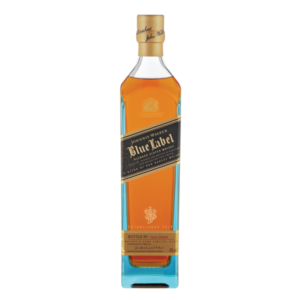
The packaging was supremely tasteful. Unlike some deluxe whisky bottles that resemble oversized perfume flasks, Blue Label’s bottle was cast from a 19th-century Johnnie Walker bottle mold in pale green flint glass, with a stopper cork and little lead seal on the neck. Each bottle is individually numbered, reinforcing exclusivity and craftsmanship.
In 2005, Johnnie Walker created one of the most unusual Blue Label bottlings: the 1805 edition (named after John Walker’s birth year) comprising 9 whiskies aged 45-70 years. Only 200 bottles were produced as private gifts for individuals “who made significant contributions to modern life.” A few bottles later surfaced at auction, achieving five-figure prices.
Recent years have seen innovative releases: Blue Label Ghost & Rare editions exploring closed distilleries, limited edition collaborations (like the Year of the Snake with artist James Jean), and in 2024, Blue Label Ultra – the world’s lightest glass bottle at just 180g, with only 888 produced globally.
In 2025, Johnnie Walker launched the Johnnie Walker Vault – a luxury platform where Master Blender Dr. Emma Walker creates bespoke private blends starting from £50,000. The physical vault beneath Johnnie Walker Princes Street in Edinburgh holds 500 rare, aged, and ghost casks personally curated by Dr. Walker from Diageo’s 10 million casks.
From humble grocery shop to global luxury icon, Blue Label represents 200+ years of blending mastery culminating in one exceptional whisky.
Production Method: One in 10,000 Casks
The magic of Blue Label lies in ruthless selection. Diageo produces 11 million casks per year across its portfolio, but only one in every 10,000 casks meets Blue Label’s exacting standards. Age matters, but it’s not the deciding factor. Industry estimates suggest some whiskies in Blue Label can be several decades old – often reaching 40-50 years – though exact ages aren’t confirmed since Blue Label has no age statement.
Current Master Blender Dr. Emma Walker (who took over from legendary Jim Beveridge) sources whiskies from multiple Diageo distilleries to create Blue Label. Known distilleries include:
Speyside: Benrinnes, Cardhu (which Johnnie Walker acquired in 1893) Highlands: Clynelish, Royal Lochnagar, Oban Islay: Caol Ila, Port Ellen (a legendary ghost distillery) Grain: Cameronbridge, plus ghost distilleries Port Dundas and Caledonian
However, Dr. Walker never reveals exactly which distilleries or vintages appear in each batch. “We have to remain flexible across the company’s inventory,” she explains. The whisky reserves are “like a living, breathing animal that changes from minute to minute. There’s new spirit going into it, and whisky always going out.”
The blending philosophy follows traditional methods used for 100+ years. Blue Label is built from sub-blends – smaller component blends that form the larger final blend. One sub-blend might focus on sherry notes, another on smoke, another on fruit character. These are carefully combined to achieve Blue Label’s signature profile.
What makes each sub-blend exceptional is the rarity of the casks. Ghost distillery whiskies (from closed distilleries that can never produce again) add irreplaceable character. Long-aged malts provide complexity and depth. Highland malts contribute honey and elegance. Islay malts deliver waves of smoke. Speyside malts offer fruit and floral notes. Grain whiskies provide smoothness and structure.
After blending, the whisky is bottled at 40% ABV (standard for Scotch sold in most markets) or 43% ABV (for some markets including the US). The liquid is then presented in those iconic individually-numbered bottles, ensuring each one can be traced back to its production batch.
Alcohol Percentage: Premium Strength
Johnnie Walker Blue Label is bottled at 40% ABV (80 proof) for most global markets, including South Africa, and 43% ABV (86 proof) for select markets like the United States.
At 40% ABV, Blue Label sits at the standard strength for premium Scotch whisky:
- Legal minimum for Scotch: 40% ABV
- Blue Label: 40% ABV (SA, UK, most markets)
- Blue Label: 43% ABV (US, select markets)
- Johnnie Walker Black Label: 40% ABV
- Johnnie Walker Green Label: 43% ABV
The 40% ABV delivers perfect balance between power and elegance. Higher ABV would create heat that masks delicate flavours; lower ABV would lack structure and presence. After decades of aging, these rare whiskies have naturally mellowed, making 40% ABV ideal for showcasing their complexity without overwhelming the palate.
This is whisky designed for contemplative sipping, not shooting. At 40% ABV with this level of complexity, Blue Label rewards slow appreciation – letting it breathe in the glass, nosing the evolving aromas, and taking small sips that coat your entire palate.
Number of Calories: Luxury Without Excess
At 40% ABV with no added sugars (just whisky, water, and natural barrel influences), Johnnie Walker Blue Label contains calories purely from alcohol:
- 25ml single shot: ~56 calories
- 35ml pour: ~78 calories
- 50ml double: ~112 calories
- 750ml bottle: ~1,680 calories total
These numbers come from pure ethanol content (7 calories per gram of alcohol). Blue Label contains zero carbohydrates, zero sugar, zero fat, and trace protein from the grain – all calories are from alcohol itself.
For comparison per 25ml shot:
- Blue Label (40% ABV): ~56 calories
- Vodka (40% ABV): ~55 calories (identical)
- Red wine (150ml glass, 13% ABV): ~125 calories
- Beer (330ml, 5% ABV): ~135-150 calories
Blue Label is keto-friendly and low-carb compatible. However, at R3,500-R4,500 per bottle, if you’re worrying about calories while drinking Blue Label, you’re probably missing the point. This is about savoring exceptional craftsmanship, not counting macros.
Tasting Notes: Velvety Complexity
Johnnie Walker Blue Label delivers dimensional complexity that justifies its premium positioning. Here’s what Master Blenders and experts describe:
Appearance: Rich golden amber with brilliant clarity. In the glass, it glows with warm copper tones acquired from decades in oak casks.
Nose: Mellow and rounded with dry smokiness combined with raisin sweetness. Expect hazelnuts, honey, rose petals, sherry, and oranges. Some detect kumquats, aromatic smoke, sandalwood, tobacco, and dark chocolate. With age (in well-cellared bottles), Blue Label develops a “fresh-toast-and-coffee bouquet” according to wine expert Serena Sutcliffe – one of Champagne’s most intriguing scents.
Palate: Velvety smooth and vibrant with layers of incredible flavour. Initial fruit (plums, raisins, dried apricots) gives way to smoke, honey, hazelnuts, and subtle spice. Mid-palate reveals orange marmalade, dark chocolate, vanilla, and oak influence. The smoke is elegant – waves rather than walls – creating luxurious complexity. Sherry cask influence adds sweet richness balanced by dry malt character.
Mouthfeel: Silky, coating, luxurious. The texture is remarkably smooth despite 40% ABV – decades of aging have mellowed any harsh edges. Medium-bodied with perfect viscosity – neither thin nor heavy.
Finish: Long, smooth, and elegant. The aftertaste lingers for 30+ seconds with waves of smoke, dried fruit, honey, and gentle oak spice. The finale is refined and dignified, fading gracefully rather than dropping off abruptly. This is where decades of maturation truly shine.
Blue Label is described as having “richness and smoke, layers of honey and fruit and a smooth finish” – approachable enough for whisky newcomers yet complex enough for connoisseurs. It’s balanced, refined, and unmistakably luxurious.
Best Served With: The Ritual of Appreciation
Blue Label deserves proper appreciation. Here’s how to serve it:
Serving Ritual
- Use a proper whisky tumbler or Glencairn glass (never shots)
- Pour 25-35ml (don’t overpour – savor it)
- Add a few drops of room-temperature water to open up aromas (optional but recommended)
- Nose the whisky for several minutes before sipping
- Take small sips, letting liquid coat your entire palate
- Breathe out slowly through your nose (retronasal olfaction)
- Sip over 30-60 minutes, allowing whisky to evolve in the glass
Temperature
Serve at room temperature (18-20°C). Never add ice to Blue Label – it numbs flavours and aromas you’re paying premium prices to experience. If you prefer chilled whisky, use whisky stones (non-diluting chilled stones) rather than ice.
Food Pairings
Cheese: Aged Parmigiano-Reggiano, mature cheddar, Stilton, Roquefort Chocolate: Dark chocolate (70%+ cacao), chocolate truffles Meat: Dry-aged ribeye, Karoo lamb, game meat, biltong (quality, aged) Desserts: Dark chocolate torte, pecan pie, sticky toffee pudding Cigars: Premium hand-rolled cigars (Cuban or Dominican) for the full luxury experience
Many purists argue Blue Label is best enjoyed alone – no food, no cigars, just pure contemplation of exceptional whisky. This is valid. The complexity rewards undivided attention.
Occasions
Blue Label is reserved for:
- Major career achievements (promotions, retirements, business successes)
- Milestone celebrations (50th birthday, anniversaries, graduations)
- Once-in-a-lifetime moments (weddings, births, major victories)
- Impressing connoisseurs and collectors
- Investment purchases (some bottles appreciate over time)
This isn’t everyday whisky. This is liquid saved for moments worth remembering.
Where to Buy: Luxury Within Reach
Specific Retailers (South Africa)
WhiskyBrother (Online) Product: Johnnie Walker Blue Label Scotch Whisky 750ml Bottled at: 43% ABV Distilleries: Cardhu, Clynelish, Benrinnes, Islay malts Website: whiskybrother.com Free SA shipping on orders over R500
Whisky Marketplace South Africa Product: Johnnie Walker Blue Label 750ml Website: whiskymarketplace.co.za Note: Price comparison platform showing best local deals
Mothercity Liquor (Cape Town – Online) Product: Johnnie Walker Blue Label 750ml Delivery: 0-2 days (Cape Town), 2-5 days (rest of SA) Express delivery: 1-3 working days available Website: mothercityliquor.co.za
PicardiReBEL (Online) Product: Johnnie Walker Blue Label 750ml Website: picardirebel.co.za Delivery available
Urban Spirits Product: Johnnie Walker Blue Label (including limited editions like Year of the Snake) Website: urbanspirits.co.za
Norman Goodfellows Multiple locations: Johannesburg, Pretoria, Cape Town, Durban Products: Blue Label core range and limited editions Website: ngf.co.za
Makro Available: Premium Makro stores with luxury liquor sections Check: In-store for Blue Label availability
Pick n Pay / Checkers Available: Selected stores with premium liquor sections Check: Local store availability (limited stock)
Prices (South Africa, 2025)
Retail Bottle Prices (750ml):
- Johnnie Walker Blue Label (standard): R3,500-R4,500
- Blue Label Limited Editions: R4,500-R6,500
- Blue Label Ghost & Rare: R5,500-R8,000
- Blue Label King George V: R12,000-R18,000
- Blue Label Ultra (if available): R30,000+ (888 bottles globally)
International Reference:
- Average global price: $171 USD (~R3,200) per 750ml
- UK retail: £120-£180 (~R2,850-R4,275)
- US retail: $200-$250 (~R3,750-R4,700)
Restaurant/Club Pricing:
- Casual upmarket restaurants: R600-R900 per 25ml pour
- Premium hotel bars: R800-R1,200 per pour
- Exclusive clubs (Sandton, Cape Town): R1,000-R1,500 per pour
- Luxury establishments: R1,200-R2,000 per pour
Special Editions:
- Year of the Snake (2025): R4,500-R5,500
- Blue Label 1805 (secondary market): R300,000+ (extremely rare, 200 bottles worldwide)
Pricing Notes:
- Prices fluctuate with Rand/Pound/Dollar exchange rates
- Limited editions appreciate over time – some are investment pieces
- Duty-free prices at OR Tambo: R2,800-R3,500 (can save R500-R1,000)
- Always verify authenticity when buying from private sellers or auctions
FAQs: Everything You Need to Know
Why is Johnnie Walker Blue Label so expensive? Blue Label costs R3,500-R4,500 because only one in every 10,000 casks from Diageo’s 11 million annual casks meets its standards. It contains rare whiskies aged 40-50+ years, includes irreplaceable ghost distillery stock (from closed distilleries), requires Master Blender artistry honed over generations, and comes in individually numbered bottles with premium packaging. You’re paying for extreme rarity, decades of aging, and exceptional quality – not just marketing.
Does Johnnie Walker Blue Label have an age statement? No, Blue Label has no age statement (it’s “NAS” – no age statement). This gives Dr. Emma Walker flexibility to select the finest whiskies regardless of age. While age plays a role, taste and quality are deciding factors. Industry estimates suggest Blue Label contains whiskies aged 40-50+ years, with some special editions using whiskies aged 45-70 years. The lack of age statement allows for consistency across batches despite changing inventory.
What’s the difference between Blue Label and Black Label? Johnnie Walker Black Label (R450-R650, 12-year-old, 40% ABV) is a premium everyday Scotch using quality whiskies aged minimum 12 years. Blue Label (R3,500-R4,500, no age statement, 40% ABV) is ultra-premium using only 1 in 10,000 exceptional casks with whiskies often aged 40-50+ years. Black Label is your Friday night whisky; Blue Label is once-in-a-lifetime celebration whisky. Both are excellent, but they serve different purposes and budgets.
Is Johnnie Walker Blue Label worth the price? Worth is subjective. For special occasions, collectors, connoisseurs, and those celebrating major achievements, absolutely – you’re buying exceptional rarity and craftsmanship. For casual drinking or people new to whisky, probably not – start with Black Label (R450-R650) or Gold Label Reserve (R900-R1,200) to develop your palate first. Blue Label delivers world-class complexity, but you need experience to appreciate what makes it special.
Can you mix Johnnie Walker Blue Label in cocktails? Technically yes, but it’s considered sacrilege by whisky purists. At R3,500-R4,500 per bottle (R140-R180 per 25ml), using Blue Label in cocktails is wasteful. The complexity and rare whiskies are masked by mixers. Save Blue Label for neat sipping and use Black Label (R450-R650) for cocktails – it’s specifically designed for mixing and delivers excellent results at fraction of the price.
How should Blue Label be stored? Store upright in a cool (15-20°C), dark place away from direct sunlight and temperature fluctuations. Whisky doesn’t age in the bottle, so it won’t improve with storage. Once opened, consume within 1-2 years for optimal flavour, though the 40% ABV means it won’t spoil. Unopened bottles last indefinitely if stored properly. Some collectors buy Blue Label as investment – unopened bottles can appreciate, especially limited editions.
Should I add water to Johnnie Walker Blue Label? Yes! Adding a few drops of room-temperature water “opens up” the whisky, releasing aromatic compounds and softening alcohol burn. Master Blenders recommend it. Start with 2-3 drops, nose and taste, then add more if desired. Never add ice – it numbs flavours. Water at room temperature preserves complexity while making the whisky more approachable.
What does “one in 10,000 casks” really mean? Diageo produces approximately 11 million casks per year across all its distilleries. Of these, only about 1,100 casks (0.01%) meet Blue Label’s selection standards. That’s extreme selectivity. Master Blenders reject 9,999 casks for every one that’s good enough. This ruthless selection ensures only the finest, most characterful whiskies make it into Blue Label, justifying the premium price.
Whether you’re celebrating career triumphs, building a luxury collection, or searching for the ultimate gift for someone who has everything, Johnnie Walker Blue Label represents the absolute pinnacle of blended Scotch whisky. From John Walker’s humble grocery shop in 1820 to Master Blender Dr. Emma Walker’s vault beneath Edinburgh today, every bottle embodies 200+ years of blending mastery and the relentless pursuit of perfection.
With only one in 10,000 casks making the cut, whiskies aged 40-50+ years, and irreplaceable ghost distillery stock in every bottle, Blue Label isn’t just whisky – it’s liquid history, crafted for extraordinary occasions and those who refuse to settle for anything less than exceptional.
So when that moment comes – the promotion, the retirement, the once-in-a-lifetime celebration – reach for the blue. Pour slowly, nose deeply, sip deliberately, and taste 200 years of excellence in every drop.
Keep Walking toward greatness – with Johnnie Walker Blue Label as your companion for life’s finest moments.
Sláinte (that’s Scottish Gaelic for “cheers”) – or as we say in South Africa, Gesondheid to the good life!