
Guinness Beer – Ireland’s Liquid Gold That’s Been Perfecting Pints Since 1759
There’s something almost magical about watching a pint of Guinness settle – that mesmerizing cascade of bubbles, the slow transformation from dark ruby to perfect black with a creamy white head. This isn’t just beer; it’s a 265-year-old legacy in every glass. Whether you’re already a Guinness fan or you’ve been intimidated by “the black stuff,” it’s time to get properly acquainted with the world’s most famous stout. Here’s everything you need to know about Guinness, from its rebellious Irish roots to why it deserves a permanent spot in your fridge.
- Guinness Beer – Ireland's Liquid Gold That's Been Perfecting Pints Since 1759
- History: From a 9,000-Year Lease to Global Domination
- Production Method: Four Ingredients, 265 Years of Expertise
- Alcohol Percentage Of Guinness: Lighter Than You Think
- Number of Calories Of Guinness: Surprisingly Sensible
- Tasting Notes: Black Magic in a Glass
- Where to Buy Guinness Beer: Finding Your Perfect Pint
- FAQs: Your Guinness Questions Answered
History: From a 9,000-Year Lease to Global Domination
Guinness’s story begins with one of history’s boldest business moves. On December 31, 1759, a 34-year-old Arthur Guinness signed a 9,000-year lease on St. James’s Gate Brewery in Dublin for just £45 per year. Talk about confidence! The four-acre site had been an abandoned brewery, but Arthur saw potential where others saw failure.
Initially, Arthur brewed only ales. However, in the 1770s, a new type of beer called porter was taking London by storm. Porter, named after the street and river porters who loved it, was brewed with roasted barley, giving it a rich dark colour and unique flavour. Arthur recognized a winner and started brewing his own version around 1778. By 1799, Guinness porter was so successful that Arthur stopped brewing ale entirely and focused solely on the dark stuff.
Arthur wasn’t just a brilliant brewer – he was ahead of his time in business ethics. Guinness paid around 10% higher than the average industrial wage in Dublin, and by 1870, the brewery established a medical centre providing free healthcare to employees and their families. By the 1880s, every employee had a pension scheme, paid annual holidays, free meals, and even a beer allowance. This progressive treatment of workers created fierce loyalty and, as Arthur understood, happier employees made better beer.
The brewery became Ireland’s largest by 1838 and the world’s largest by 1886, producing 1.2 million barrels annually. Arthur Guinness passed away in 1803 at age 78 (impressive for that era), but the business remained in family hands for five successive generations. His signature, still printed on every can and bottle today, became one of the world’s most recognizable symbols.
By 1862, Guinness created a trademark featuring Arthur’s signature and the harp – an ancient Irish symbol. The trademark was so iconic that when the Irish Free State adopted the harp as their national symbol in 1922, they had to reverse it (facing left instead of right) to avoid infringing on the Guinness trademark. Imagine being so legendary that a country has to design around your logo!
In 1959, to celebrate the 200th anniversary of Arthur’s lease, Guinness developed a revolutionary nitrogen dispensing system that created finer, smaller bubbles than conventional draft systems. This nitrogen innovation gave Guinness Draught its distinctive creamy head and smooth texture. Then in 1988, they launched the game-changing widget – a small plastic ball inside cans that releases nitrogen when opened, recreating the draft experience at home. The widget won the Queen’s Award for Technological Achievement in 1991.
Today, Guinness is brewed in almost 50 countries, available in over 120, and over 10 million glasses are enjoyed daily worldwide. The brand is now owned by Diageo (formed from the 1997 merger of Guinness PLC and Grand Metropolitan), but it retains its Irish soul and continues brewing at St. James’s Gate. The Guinness Storehouse, opened in 2000, has become Ireland’s most popular tourist attraction, welcoming over 20 million visitors.
Production Method: Four Ingredients, 265 Years of Expertise
Despite its complex flavour, Guinness is made from just four natural ingredients: water, malted barley, roasted unmalted barley, hops, and yeast. Water makes up more than 90% of the beer, and Guinness uses high-quality Irish water to ensure purity and consistency.
The magic starts with barley. Guinness uses both malted barley (barley that’s been soaked, germinated, and dried to convert starches into fermentable sugars) and roasted unmalted barley. The unmalted barley is roasted similarly to coffee beans, which gives Guinness its distinctive dark colour and rich, roasted flavour. This roasting process was a relatively modern addition in the mid-20th century but has become essential to Guinness’s character.
Hops are added to provide bitterness, aroma, and natural preservation. Guinness uses a proprietary hop blend that balances the sweet malt flavours. The Guinness yeast strain – a particular variety passed down through generations – ferments the sugars to produce alcohol and CO2. For many years, Guinness blended aged brew with freshly brewed beer to give a sharp lactic acid flavour, though the company now refuses to confirm whether this still occurs.
The nitrogen innovation is what truly sets Guinness Draught apart from other beers. When poured, Guinness is mixed with nitrogen and carbon dioxide gas. The nitrogen creates much finer, smaller bubbles than CO2 alone, resulting in that legendary thick, creamy head and velvety mouthfeel. This is why Guinness has that distinctive “surge and settle” effect when poured – the nitrogen bubbles are so small and dense that they create that mesmerizing cascade.
The famous two-part pour is essential: tilt the glass at 45 degrees, fill three-quarters full, let it settle, then top it off straight. This process takes 119.5 seconds (yes, they’ve timed it) and allows the nitrogen bubbles to properly settle, creating that perfect creamy head with a slight dome.
Alcohol Percentage Of Guinness: Lighter Than You Think
Here’s a surprise: despite its rich, bold flavour, Guinness Draught has an alcohol by volume (ABV) of just 4.2%. That’s actually lower than most beers! For comparison, the average beer ABV is 5%, making Guinness Draught technically a light beer in terms of alcohol content.
This moderate ABV is part of Guinness’s genius – it’s sessionable, meaning you can enjoy multiple pints without being completely paralytic. The rich flavour tricks your brain into thinking it’s stronger than it actually is.
However, Guinness comes in several varieties with different alcohol contents:
- Guinness Draught: 4.1-4.3% ABV (the classic)
- Guinness Original/Extra Stout: 5.6% ABV (stronger, more bitter)
- Guinness Foreign Extra Stout: 7.5% ABV (exported version, bolder)
- Guinness Special Export: 8% ABV (strongest variety)
- Guinness 0: 0% ABV (non-alcoholic, all the taste)
The lower ABV of Guinness Draught makes it perfect for long afternoons at the pub, Sunday braais, or watching rugby without writing off the next day. At 4.2% ABV, it’s strong enough to give you a pleasant buzz but mild enough to keep you functional.
Number of Calories Of Guinness: Surprisingly Sensible
Another myth-buster: Guinness isn’t a calorie bomb. A standard 355ml (12 fl oz) serving of Guinness Draught contains just 125 calories. For context, many craft beers contain 180-200 calories per serving. Even regular lagers often pack 140-160 calories.
The calorie breakdown looks like this:
- Calories from alcohol: Approximately 78 (about 62% of total)
- Carbohydrates: 9.4g per serving
- Fat: 0g
- Protein: Minimal
The lower alcohol content directly contributes to the lower calorie count, since alcohol provides 7 calories per gram. Guinness’s relatively dry profile (low residual sugar) also keeps calories in check.
For a full 440ml can (the size commonly sold in South Africa), you’re looking at approximately 155 calories. A six-pack of Guinness Draught (6 x 440ml) totals around 930 calories – about the same as a large pizza slice and a half.
If you’re watching your intake, Guinness is actually one of the smarter beer choices. It’s lower in calories than most craft IPAs, stouts from other breweries, and even many lagers. The rich, satisfying flavour also means you might drink fewer overall.
Tasting Notes: Black Magic in a Glass
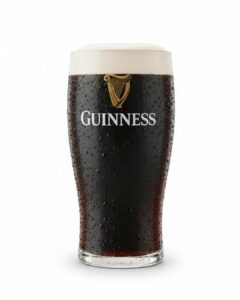
Let’s get one thing straight: Guinness isn’t actually black. It’s officially described as a very dark shade of ruby red, though you’d be forgiven for calling it “the black stuff.” When held up to bright light, you can see that deep ruby glow.
Appearance: Dark ruby-red to black with exceptional clarity. The creamy white to tan head is thick, dense, and persistent – it should leave lacing down the glass as you drink.
Nose: Rich and inviting with aromas of roasted coffee, dark chocolate, toasted bread, and subtle hints of caramel. There’s a clean, malt-forward character without any off-putting yeasty or sour notes.
Palate: The initial sip delivers smooth, creamy texture thanks to nitrogen. You’ll taste roasted malt with coffee and chocolate notes, balanced by a gentle hop bitterness. There’s a slight sweetness from the malt that perfectly counters the roasted barley’s bitterness. The flavour is bold but never harsh or overwhelming.
Mouthfeel: This is where Guinness shines. The nitrogen creates an incredibly smooth, velvety, almost silky texture. It feels substantial without being heavy. The carbonation is gentle – no harsh fizz.
Finish: Clean, dry, and slightly bitter with lingering roasted notes. The finish invites another sip rather than overwhelming your palate. There’s a subtle coffee-like bitterness that lingers pleasantly.
Guinness strikes a perfect balance between bitter, sweet, and roasted notes. It’s complex enough to appreciate but approachable enough for anyone. The nitrogen makes it dangerously easy to drink despite the bold flavours.
Where to Buy Guinness Beer: Finding Your Perfect Pint
Guinness is widely available across South Africa at major retailers, specialty liquor stores, pubs, and online platforms.
Specific Retailers
Makro Product: Guinness Draught Stout 440ml cans Available in: Single cans, 6-packs, and 24-pack cases Also stocks: Guinness Foreign Extra Stout bottles Website: makro.co.za Note: Often has promotional pricing on bulk purchases
Woolworths Product: Guinness Draught 24 x 440ml cans Available at: Woolworths stores with liquor sections nationwide Website: woolworths.co.za Note: Premium retailer with consistent stock
Pick n Pay Product: Guinness varieties (Draught and Foreign Extra Stout) Available at: Pick n Pay Liquor stores nationwide Website: pnp.co.za Note: Check local store for availability
Checkers Product: Guinness Draught cans and bottles Available at: Checkers Liquor stores nationwide Website: checkers.co.za
Mothercity Liquor (Cape Town – Online) Product: Guinness Draught 440ml cans (6-packs) Product: Guinness Foreign Extra Stout 325ml bottles Location: Montague Gardens warehouse, Western Cape Delivery: 0-2 days (Cape Town), 2-5 days (rest of SA), Express delivery available (1-3 days) Website: mothercityliquor.co.za Contact: Orders via website
Norman Goodfellows Multiple locations: Johannesburg, Pretoria, Durban, Cape Town Product: Guinness Draught and Extra Stout varieties Website: ngf.co.za Note: Knowledgeable staff and excellent selection
Liquor City Locations: Nationwide chain Product: Guinness varieties in cans and bottles Website: liquorcity.co.za Note: Check local branch for stock availability
Pubs, Restaurants & Clubs Available on tap at most Irish pubs, sports bars, and upmarket restaurants across South Africa Notable spots: O’Hagans (Johannesburg), Ferryman’s Tavern (Cape Town), The Beer Café (Durban)
Prices
Retail Prices (6-pack of 440ml cans):
- Budget retailers (Makro, Shoprite): R130-R150
- Standard retailers (Pick n Pay, Checkers): R145-R170
- Premium retailers (Woolworths): R160-R180
24-Pack (24 x 440ml cans):
- Makro/Shoprite: R490-R550
- Pick n Pay/Checkers: R530-R600
- Woolworths: R580-R650
Single 440ml Can:
- Convenience stores: R25-R35
- Bottle stores: R22-R30
Guinness Foreign Extra Stout (325ml bottle):
- Single bottle: R18-R25
- 6-pack: R100-R135
Pub/Restaurant Prices (per pint, approximately 500ml):
- Casual pubs/sports bars: R50-R70
- Mid-range restaurants: R65-R85
- Upmarket establishments/hotels: R80-R110
- Clubs (Sandton, Cape Town Waterfront, Umhlanga): R90-R130
Pricing Notes:
- Prices fluctuate based on location and promotions
- Bulk buying (24-packs) offers better value per can
- Watch for specials during major sporting events (Six Nations, Rugby World Cup)
- Makro consistently offers competitive pricing
FAQs: Your Guinness Questions Answered
Why does Guinness taste different in Ireland? This is one of beer’s great debates! Many people swear Guinness tastes better in Ireland. Scientifically, Guinness brewed in Dublin for the Irish market is identical to Guinness brewed for export. However, factors like freshness (shorter distance from brewery), proper pouring technique (Irish bartenders are trained experts), glassware cleanliness, and even psychological expectation can affect the taste. The real difference might just be the atmosphere of enjoying it in an authentic Irish pub!
How long does Guinness take to pour properly? The perfect pint of Guinness takes 119.5 seconds using the two-part pour method. Tilt the glass at 45 degrees, pour until three-quarters full, let it settle (this takes about 60-90 seconds as the surge settles), then top it off straight. This allows the nitrogen bubbles to properly form that iconic creamy head. Rushing the pour results in a flat, disappointing pint.
Can you drink Guinness from the can, or must it be in a glass? You can drink Guinness straight from the can thanks to the widget, which creates the nitrogen effect when opened. However, pouring it into a glass dramatically improves the experience. You’ll see the beautiful cascade, smell the aromatic coffee and chocolate notes, and enjoy the proper creamy head. The visual and aromatic experience is half the pleasure, so grab a glass!
Is Guinness vegan? Yes! As of 2017, Guinness Draught, Guinness Extra Stout, and Guinness Foreign Extra Stout are all vegan-friendly. Guinness upgraded to a new state-of-the-art filtration process that removed the use of isinglass (fish bladder), which was previously used for filtration. This makes Guinness suitable for vegans and vegetarians.
What’s the difference between Guinness Draught and Extra Stout? Guinness Draught (4.2% ABV) is served with nitrogen, creating that creamy, smooth texture with a thick head. It’s milder and more approachable. Guinness Extra Stout (5.6% ABV in North America) is stronger, crisper, and more bitter. It’s carbonated with CO2 like regular beer, giving it a sharper, more effervescent character. Draught is smooth and creamy; Extra Stout is bold and crisp.
Why is there a widget in Guinness cans? The widget is a small plastic ball containing nitrogen gas. When you open the can, the sudden pressure release forces the nitrogen out through tiny holes in the widget, creating those fine nitrogen bubbles throughout the beer. This recreates the draft experience at home, giving you that signature creamy head and smooth texture. It’s genuinely revolutionary technology that won the Queen’s Award for Technological Achievement.
Is Guinness actually good for you? The famous 1920s slogan “Guinness is good for you” has no real health claim backing it. While Guinness contains antioxidants and some B vitamins, it’s still alcohol and should be enjoyed in moderation. The myth that Guinness is “healthy” likely stems from its iron content (minimal) and the fact that it was sometimes given to pregnant women and blood donors in the past (not recommended today). Enjoy it for what it is: a delicious beer, not a health tonic.
What food pairs best with Guinness? Guinness’s roasted, slightly bitter profile pairs brilliantly with rich, fatty foods. Try it with beef stew, braai meat (especially lamb chops or ribeye), fish and chips, oysters (classic Irish pairing), mature cheddar, chocolate desserts, or traditional Irish dishes like shepherd’s pie. The beer’s bitterness cuts through fat while the roasted malt complements charred, grilled flavours. For a proper South African twist, pair it with biltong, droëwors, or bobotie.
Whether you’re a long-time Guinness fan or you’ve been intimidated by its dark appearance and legendary status, now’s the time to embrace “the black stuff.” With 265 years of brewing perfection, revolutionary nitrogen technology, and that unmistakable creamy head, Guinness delivers an experience that transcends ordinary beer. So grab a six-pack, master the two-part pour, and discover why over 10 million people worldwide raise a pint of Guinness every single day.
To Arthur Guinness – the man with the 9,000-year vision and the brew that conquered the world. Sláinte (that’s Irish for “cheers”) – or as we say in South Africa, Gesondheid!